



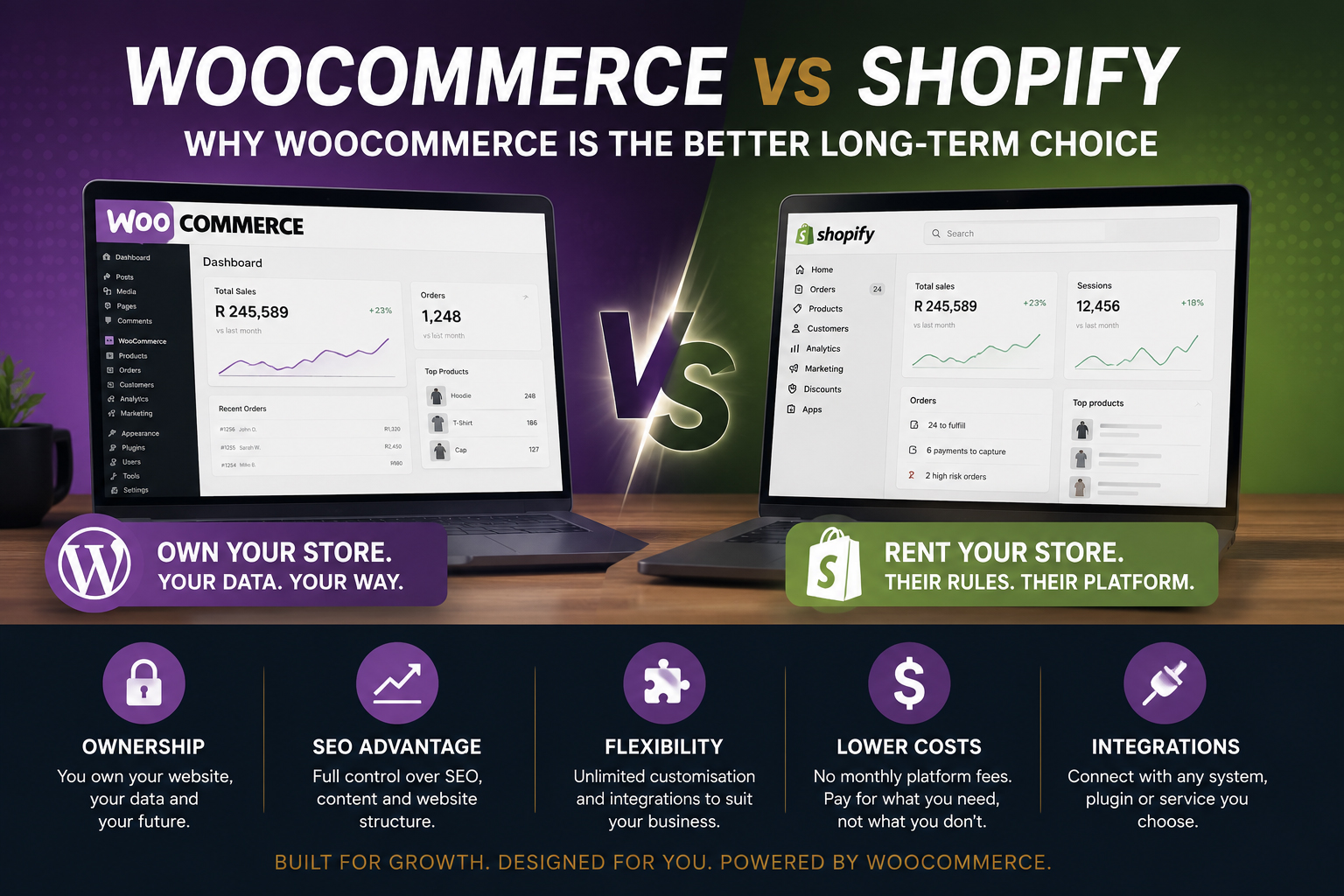
27 Jul Here are the Top 10 Reasons to Choose WooCommerce Over Shopify.

Choosing the right eCommerce platform is one of the most important decisions you’ll make when launching or growing an online business. While WooCommerce and Shopify are both excellent platforms, they differ significantly in terms of ownership, flexibility, ongoing costs and long-term scalability. The platform you choose today can influence everything from your SEO performance and payment gateway options to your ability to customise and grow your online store in the future.
In this guide, we compare the Top 10 advantages of WooCommerce over Shopify, with a particular focus on South African businesses. From complete ownership and lower long-term costs to better SEO, unlimited customisation and greater payment gateway flexibility, we’ll explain why WooCommerce is often the smarter investment for businesses looking to build a scalable and future-proof online store.
Let’s explore the key reasons why so many businesses choose WooCommerce as their preferred eCommerce platform.
1. You Own Your Website
With WooCommerce, your website belongs to you. You’re free to choose your hosting provider, developer and technology stack. You’re not tied to a single platform or monthly subscription.
Winner: WooCommerce ⭐⭐⭐⭐⭐
2. Lower Long-Term Running Costs
Shopify’s monthly subscription, paid apps and additional transaction fees can add up over time.
WooCommerce has no platform subscription, you simply pay for your hosting and any premium plugins you choose.
Winner: WooCommerce
3. No Extra Transaction Fees (South Africa)
This is huge.
Because Shopify Payments isn’t available in South Africa, merchants must use third-party gateways and may also pay Shopify an additional transaction fee on top of the gateway fee.
WooCommerce doesn’t charge these additional platform transaction fees.
Winner: WooCommerce
4. Better SEO
WooCommerce runs on WordPress, the world’s leading content management system.
That gives you:
- Better blogging
- More SEO plugins
- Greater control over metadata
- Schema markup
- URL structure
- Internal linking
For businesses relying on Google traffic, this is a major advantage.
Winner: WooCommerce
5. Unlimited Customisation
Need something unusual?
WooCommerce can be customised almost without limit.
Shopify is excellent for standard online stores, but highly customised functionality may require workarounds or simply isn’t possible within the platform’s constraints.
Winner: WooCommerce
6. Better API Integrations
This is one people overlook.
Need to connect:
- Suppliers
- Accounting
- ERP
- CRM
- Booking systems
- Memberships
- Custom software
WooCommerce is far easier to integrate because you have direct access to WordPress and its underlying code.
This is especially relevant if you’re building complex stores like supplier-fed or dropshipping businesses.
Winner: WooCommerce
7. Freedom to Choose Any Hosting
With Shopify you’re hosted by Shopify.
With WooCommerce you decide:
- Shared Hosting
- VPS
- Dedicated Server
- Cloud
- Managed WordPress
High-performance WooCommerce hosting
As your business grows, your hosting grows with it.
Winner: WooCommerce
8. Easier Content Marketing
Blogs still drive online sales.
WordPress remains the world’s best blogging platform.
Publishing articles, guides and educational content is significantly more powerful than using Shopify’s blogging tools.
For SEO-driven businesses, this is a major advantage.
Winner: WooCommerce
9. You’re Never Locked Into One Platform
If you want to change:
- Hosting
- Developer
- Theme
- Plugins
You can. Your business isn’t dependent on one company’s pricing, policies or roadmap. That’s valuable peace of mind.
Winner: WooCommerce
10. It Grows With Your Business
Many Shopify stores start simple…
Eventually they need:
- Custom pricing
- Wholesale
- Advanced shipping
- Supplier feeds
- ERP integration
- Booking systems
- Memberships
- Complex product options
- This is where WooCommerce really shines.
Instead of rebuilding your website later, you start with a platform capable of growing alongside your business.
Winner: WooCommerce
A Few Downsides to Mention
- Shopify is easier for beginners.
- Shopify handles hosting, security and updates.
- Shopify is often quicker to launch.
- Shopify’s admin interface is very polished, but so is WooCommerce.
- Shopify is excellent for straightforward retail stores.
Choosing the Right Developer Matters More Than Choosing the Platform
We’ve rescued WooCommerce websites and Shopify stores alike. A well-built store on either platform can perform exceptionally well, while a poorly planned store can become difficult and expensive to maintain.
The platform is important but the experience of the developer building and supporting your online store often has a greater impact on your long-term success.
That conclusion aligns well with Estar Web Design’s experience and reinforces your expertise without overstating the differences between the two platforms.
No Comments